
Battery Charging Best Practices to Avoid Unexpected Downtime and Overheating
Warehouse operations are a busy and fast-paced environment where every minute of productivity counts. Your material handling business is your fleet of forklifts, and the best equipment in the world will come to a screeching halt on a battery problem. At Value Forklifts, we've seen firsthand how proper forklift battery charging practices can make the difference between seamless operations and costly, unexpected downtime. It is not only knowledge of best practices in forklift battery charging, but also an understanding of protecting your bottom line and keeping your warehouse running smoothly.
The Hidden Cost of Poor Battery Management

The relationship between warehouse productivity and battery health is deeper than many operators might think. When a forklift battery fails in between shifts, the shockwave cuts through your whole operation. Orders get delayed, workers stand idle, and emergency replacements eat into your budget. But here's what many don't know: overheating is the "silent killer" of industrial batteries, gradually destroying the performance of the battery long before you are aware of it.
The consequences of not following the best practices of forklift battery safety do not only impact a single piece of equipment, but they can undermine the integrity of your entire fleet. Whether you're using forklift batteries and chargers or new equipment, the principles of good care are the same. The good news? The vast majority of battery failures can be completely avoided if the correct charging strategy is used.
Understanding the Proper Charging Cycle
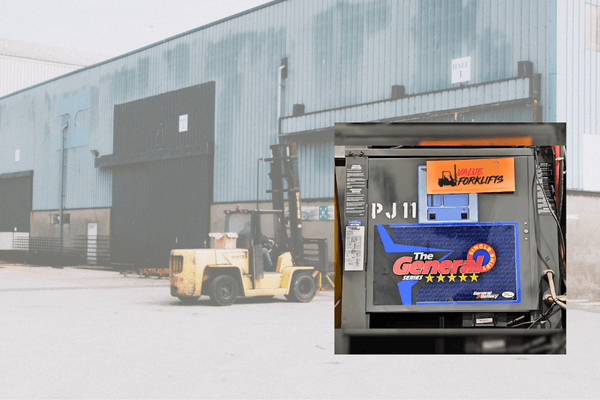
It goes without saying that before getting into best practices, it is important to define what constitutes proper industrial battery charging. The key to the battery's long life is to understand the charging regimen and observe its natural rhythms.
➞ The 8-8-8 Rule: Your Battery's Best Friend
The 8-8-8 rule for forklift batteries is the gold standard in battery management, and for good reason. This principle breaks down your batteries' 24-hour cycle into three equal parts: 8 hours of work, 8 hours of charge, and 8 hours of cool-down. This rhythm mirrors the natural chemical processes happening inside your battery and gives it the recovery time needed to maintain peak performance.
The reason is that many operators mistakenly return a freshly charged battery to service. Nevertheless, it is the 8-hour cooling time that enables the battery to stabilize by allowing the internal temperature to reach a normal level and the chemical processes to stabilize. This is one of the routes that can be taken to ensure that the battery will degrade rapidly, and the forklift battery overheating will be welcomed.
➞ Conventional, Opportunity, and Fast Charging: Know the Difference
Not every way to charge is equal, and it can be beneficial to know the distinctions between them to make more intelligent choices regarding the equipment:
- Conventional charging is based on the 8-8-8 rule and is suitable for single-shift operations. It is the most non-abrasive, comprehensive, and optimal way to charge the battery.
- Opportunity charging can be performed when taking a break and a lunch; that is why it is very popular with multi-shift operations. While convenient, this approach generates more heat and can reduce overall battery life if not managed carefully with proper forklift charger safety protocols.
- Fast charging delivers power fast, but it also produces much heat. Although it is also appropriate in high-performance settings, you cannot afford to use fast charging as your main strategy in the first place, and it is comparable to running a marathon at a quick pace; you will finish sooner. Still, you will not cope with it in the long term.
At Value Forklifts, we help customers match the right charging strategy to their operational needs, ensuring they get maximum value from their investment in used forklift batteries and chargers.
Top Best Practices to Prevent Unexpected Downtime

Avoiding forklift downtime begins with intelligent battery control. Such practices will ensure your fleet is running and minimise the need for emergency services.
➞ Don't Let It Drain Completely
Running batteries all the way to empty is one of the worst habits for forklift battery charging. A battery that depletes below 20% of its capacity will place undue stress on the cells and significantly reduce its lifespan. Think of it like repeatedly running your car until it sputters on empty eventually, you'll cause serious damage.
Develop specific guidelines for your operators regarding battery replacement or charging. Install battery discharge indicators in the event that your equipment does not have them, and choose to make it a habit never to allow batteries to go into the red range. This practice alone can extend your battery's service life by several years.
➞ Store Properly
Proper storage is not only about finding a place to park your spare batteries, but also about creating an environment that maintains the health of your batteries. Industrial battery charging should be performed in clean, dry places and not in extreme temperatures. The temperature increases the rate of chemical deterioration, and low temperatures may decrease capacity and charging efficiency.
Your battery storage should also be well-organized and have a clear labeling system. Always move the batteries so that you use them evenly throughout your fleet and never place batteries one on top of the other without a rack. Good storage also means keeping the battery free of any metal that could cause a short circuit.
➞ Keep Software Updated
Modern forklift battery systems often feature advanced charging control software that optimizes charge cycles, monitors battery health, and prevents overcharging. If your used forklift chargers support firmware updates, keeping up with manufacturer updates may improve your charging performance and battery life.
The updates are usually accompanied by sophisticated charging algorithms and real-world performance information, temperature compensation features, and improved safety measures. Ask your equipment supplier, such as Value Forklifts, whether your charging equipment is up to date.
Top Best Practices to Prevent Overheating
It is essential to learn how to prevent forklift battery overheating to sustain a safe and effective operation. Overheating not only reduces battery performance but also poses severe safety risks.
➞ Remove Cases During Charging
Several operators are unaware of the fact that battery cases or covers may trap heat during the charging process. Always remove unnecessary covers when charging the battery. This simple measure allows heat to be released naturally and can play a huge role in curbing operating temperatures.
During the charging process, heat is produced as a byproduct of the chemical processes that take place within the battery. You are also assisting your battery to retain the best temperatures during the charging process by eliminating obstacles to heat dissipation.
➞ Ensure Proper Forklift Battery Ventilation
Proper forklift battery ventilation is not an option; it is a must. Hydrogen gas is also flammable and can be explosive in large quantities, and is emitted by charging batteries. You should also have proper ventilation of the area where you store these gases to release them into the air.
Good ventilation is useful in controlling temperature, besides safety concerns. You should install a ventilation system or fans in your charging areas, and you should never charge a battery in an enclosed area without ventilation. Install charging stations in positions that are not heated, such as away from direct sunlight, away from heating vents, or away from other equipment that produces warmth.
The investment in proper ventilation infrastructure pays dividends in both safety and battery longevity. If you're unsure whether your current setup meets safety standards, consult with professionals who understand industrial battery charging requirements.
➞ Avoid Fast Charging When Possible
Although the need to have fast charging can be applied in high-demand functions, it must be the exception and not the rule. Quick charging passes current through the battery at a faster rate and produces more heat than traditional charging methods.
And if it is a must-have operation that requires swift charging, spend money on high-quality fast chargers with good temperature monitoring and cooling systems. Only charge in emergencies, then provide the batteries with additional cooling time. Alternating between conventional and fast charging, instead of using only fast charging, can assist in stabilizing the operation requirements with the health of the battery.
Signs Your Battery Is Overheating
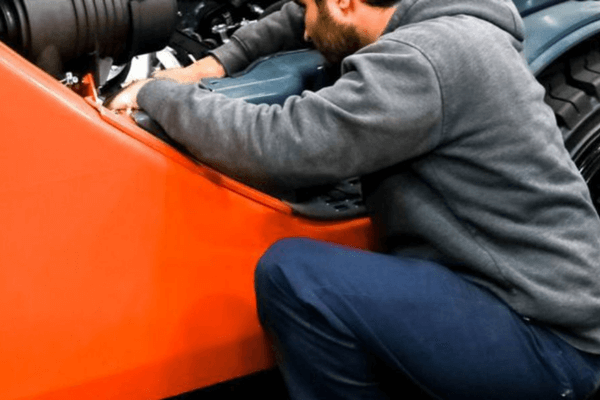
Early detection of forklift battery overheating can help to avoid life-threatening scenarios and costly damage to equipment. Train your operators to be alert to the following symptoms:
- Unusual odors are often the first indicator. A sharp, acrid smell or the distinctive scent of sulfur suggests the battery is getting too hot and potentially off-gassing more than normal. Never ignore strange smells around battery equipment.
- Excessive heat is another obvious red flag. Although it is normal for batteries to warm up through charging, they should not be so hot that touching them will cause burns to the person handling them. When you cannot place your hand on the battery casing, then it is overheating.
- Physical deformation represents a serious problem. The battery case is bulging, swelling, or warped, which means that it has accumulated internal pressure due to overheating. If there are any physical modifications to the battery's shape, take it out of service and seek professional advice.
Other warning signs include reduced runtime between charges, slower charging times, or visible corrosion around terminals. Any of these symptoms warrants immediate attention to prevent forklift downtime and potential safety hazards.
Why Choose Value Forklifts for Your Battery and Charger Needs
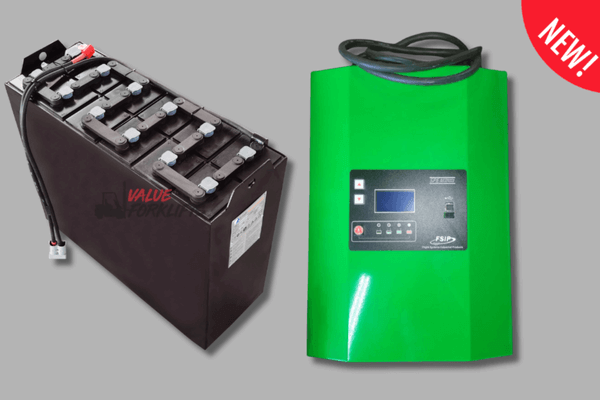
When it comes to reliable forklift battery charging solutions, Value Forklifts stands out as your trusted partner. With over 30 years of industry experience and more than 400 satisfied customers nationwide, we understand what it takes to keep your fleet running efficiently.
Our batteries and chargers are the best in the market; they are made of quality used batteries and chargers that have undergone proper inspection, servicing, and tests to ensure their performance is of high quality. We do not just sell you equipment; we give you the knowledge to adopt appropriate forklift battery safety measures that save your investment.
You may only need used forklift chargers for a single unit, or you may need to install an entire battery management system to cover your entire fleet. We have competitive pricing with the industry-leading warranties. Our team is able to assist you in evaluating your existing charging system, finding improvement points, and choosing equipment that suits your business and operational needs and budget.
We also carry an extensive assortment of used forklift batteries and chargers of all major brands, such as Toyota, Crown, Yale, Hyster, etc. We can bring solutions to you are no matter where you are.
Conclusion: Proactive Charging Saves Money
The right forklift battery charging best practices are not only about following the rules, but also about preserving your investment and making the most of your equipment. Regardless of whether you operate a fleet of new forklifts or you are getting great deals on used equipment, the same rules apply; you have to respect the 8-8-8 rule, avoid overheating due to improper ventilation, and never allow the batteries to deplete.
The financial aspect of active battery management is most apparent in the case of the used equipment. The already large savings that you are getting by buying good used forklifts and associated equipment are multiplied by extending the life of the battery by taking proper care of it. Each month you extend a battery's life is a dollar saved on replacement expenses.
Value Forklifts is dedicated to ensuring that you derive a lot of value out of your material handling equipment. A combination of our high-quality forklifts, batteries, chargers, and professional advice guarantees that you have all the necessary components for a reliable, cost-effective operation. Get in touch with us today and find out what you need.